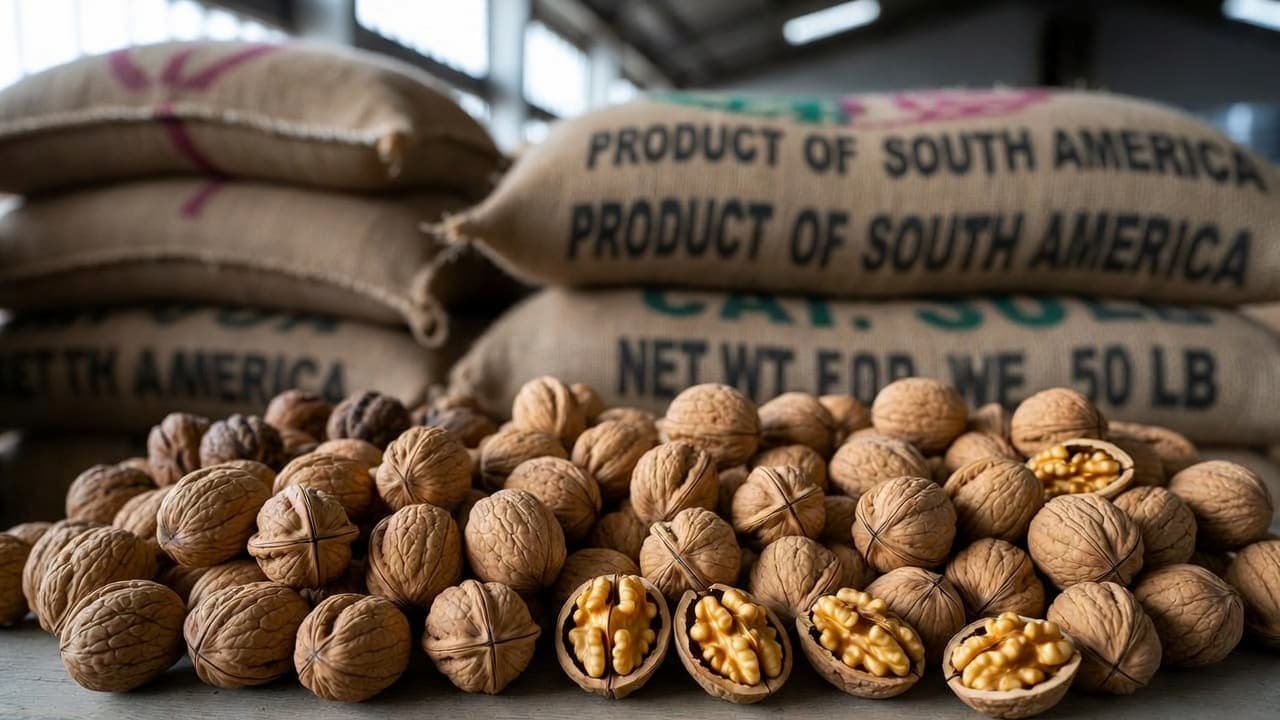
The European market imported USD 7.1 billion in tree nuts during 2024. In that same year, Italy was the main destination for Argentine in-shell walnuts, absorbing around 82% of the export value in that tariff line (HS 080231). To operate in this market, regulatory compliance is not optional: a shipment rejected at the border implies the total loss of the container.
This guide summarizes everything an importer, distributor, or industrial buyer needs to know before handling a walnut shipment from Argentina or Chile to the European Union.
1. Current regulatory framework
The European food control system is one of the most demanding in the world. For walnuts (Juglans regia) imported from third countries, compliance is based on four main regulations, all updated between 2019 and 2024:
| Regulation | Area | Description |
|---|---|---|
| (EU) 2023/915 | Contaminants | In force since April 2023. It replaced the historic (EC) 1881/2006. It establishes the maximum levels for mycotoxins, heavy metals, and other contaminants in food. |
| (EU) 2019/1793 | Border controls | Defines which products from third countries are subject to reinforced official controls or special conditions of entry due to contamination risk. Dynamic list, updated periodically. |
| (EC) 396/2005 | Pesticide residues | Legal basis for MRLs (Maximum Residue Levels). More than 200 accumulated amendments. It governs hundreds of active substances across all categories of plant-based food. |
| (EU) 2017/625 | Official controls | European Commission framework for compliance verification. It defines the obligations of designated Border Control Posts (BCPs). |
2. Mycotoxins and aflatoxins: the critical parameter
Aflatoxins are the most closely monitored toxicological risk in walnuts within the EU. The European Food Safety Authority (EFSA) classifies them as carcinogenic and genotoxic, which is why the established limits are strict and leave no room for commercial tolerance.
Maximum levels for walnuts — Regulation (EU) 2023/915
| Parameter | Limit | Condition of application |
|---|---|---|
| Aflatoxin B1 | 2 µg/kg | Direct consumption / use as an ingredient |
| Total aflatoxins (B1+B2+G1+G2) | 4 µg/kg | Direct consumption / use as an ingredient |
| Aflatoxin B1 | 5 µg/kg | Product intended for sorting or other prior physical treatment |
| Total aflatoxins (B1+B2+G1+G2) | 10 µg/kg | Product intended for sorting or other prior physical treatment |
Note: The limits of 8 µg/kg or higher appearing in the same regulation correspond to other categories (peanuts, almonds, pistachios), not to common walnuts (Juglans regia).
Sampling and analysis methods are standardized under Regulation (EC) 401/2006. Designated laboratories must be accredited in accordance with ISO/IEC 17025.
⚠ Critical documentary requirement
When a lot is marketed under the category “to be subjected to sorting or other physical treatment,” each individual package and the original accompanying document must bear the statement:
“Product shall be subjected to sorting or other physical treatment to reduce aflatoxin contamination before placing on the market for the final consumer or use as a food ingredient.”
In addition, the lot identification code must appear indelibly on each package and on the original accompanying document.
3. Pesticide residues (MRLs)
The EU manages Maximum Residue Levels (MRLs) through Regulation (EC) 396/2005. One fundamental principle: any pesticide without a specifically established MRL has a default value of 0.01 mg/kg, an extremely low threshold.
| Parameter / Substance | Limit | Reference |
|---|---|---|
| Default MRL (any substance without a specific MRL) | 0.01 mg/kg | EC 396/2005 Art. 18 |
| Ethephon (walnuts) — exempt from the general reduction to 0.02 mg/kg | Current specific MRL | EU 2024 Corrigendum |
| EU multiannual programme (EFSA) | +750 pesticides analysed in samples 2025–2027 | EU 2024/989 |
| Dioxins / PCBs | Regulated under EU 2023/915 | EU 2023/915 |
The EU updates MRLs through specific regulations several times a year. South American exporters must verify the current status before each season, especially for active substances under systematic review (Article 12 of Regulation 396/2005).
4. Physical parameters and market standards
Beyond food safety requirements, European buyers apply physical quality specifications that determine the commercial category and the price per ton. The parameters below reflect market standards and UNECE/OECD references for nuts, not uniform EU regulatory obligations. Specific contractual specifications must be agreed with each buyer.
| Parameter | Typical reference | Source / Nature |
|---|---|---|
| Maximum moisture (in-shell / whole walnut) | ≤ 12% | UNECE standard for whole walnuts |
| Maximum moisture (shelled / kernel) | ≤ 5% | UNECE standard for kernels |
| Size (whole walnut) | 28mm / 30mm / 32mm+ | EU commercial practice — defines price by category |
| Skin color (kernel) | Light / Light Brown / Dark Brown | UNECE/OECD categories |
| % halves vs pieces | ≥ 80% halves for premium | Common contractual specification |
| Foreign matter / defects | 0% tolerance in premium segments | Contractual specification |
| Rancidity (acidity index) | According to buyer specification | Private contractual parameter — consult technical source |
For industrial importers (bakeries, confectionery, food manufacturing), size consistency and breakage percentage are key factors when negotiating price and volume.
5. Official border controls in the EU
Nut shipments subject to reinforced official controls or special conditions of entry must pass through a designated BCP (Border Control Post). The application of these controls — and their frequency — depends on the product, the country of origin, and the current regulatory risk under Regulation (EU) 2019/1793. Not all walnut origins are listed in that regulation; inclusion in the annex is updated periodically depending on compliance history.
The verification process includes three types of control:
Documentary Check
Verification of the official health certificate, lot traceability documents, declarations of compliance, and analytical results from the country of origin.
Identity Check
Visual verification that the goods match the documentation: container, packaging, and labelling.
Physical Check (laboratory analysis)
Sampling and official analysis of aflatoxins, pesticide MRLs, and other contaminants. The frequency varies depending on the product, the country of origin, and the current regulatory risk — it is not a uniform percentage applicable to all South American walnuts.
Note: The European Commission provides for the approval of pre-export controls (Article 73, Regulation 2017/625). When these origin controls are approved, they may replace or significantly reduce border inspections, speeding up shipment clearance.
6. Essential checklist for South American exporters
Before confirming any shipment destined for the EU, these are the priority checkpoints:
- ISO 17025-accredited aflatoxin analysis — Performed on the lot to be shipped, not on generic seasonal samples.
- Multi-residue pesticide analysis — Coverage of the active substances used in cultivation + verification against the updated EU MRL database (EU Pesticide Database).
- Moisture verified before sealing the container — Measure after the storage process prior to shipment.
- Complete traceability documentation — Lot code, harvest date, drying process, storage, fumigation if applicable.
- Phytosanitary certificate from the country of origin — Issued by the official authority (SENASA in Argentina, SAG in Chile). Its requirement may depend on the product status and the applicable phytosanitary framework; verify case by case.
- Correct labelling on packages — If the lot exceeds direct consumption limits, include the mandatory legal statement on each package and on the original accompanying document, together with the lot identification code.
- Verify the destination BCP — Confirm that the port of entry has a BCP authorized for the type of product.
- Review MRL updates before each season — The EU issues changes several times a year; an MRL in force in the previous season may have changed.
Regulatory references
- Regulation (EU) 2023/915 — Maximum levels for contaminants in food (EUR-Lex)
- Regulation (EU) 2019/1793 — Import controls for food of risk
- Regulation (EC) 396/2005 — Pesticide MRLs (consolidated version)
- Regulation (EU) 2017/625 — Official controls in the agri-food chain
- Regulation (EC) 401/2006 — Sampling and analysis methods for mycotoxins
- UNECE standards for walnuts — unece.org
- EU Pesticide Database: food.ec.europa.eu
- RASFF — EU Rapid Alert System for Food and Feed
This article is for informational purposes. Regulatory limits are updated periodically. For commercial decisions, always verify the current version of the regulations in EUR-Lex and the European Commission’s pesticide database.
Raíz Andina · Premium Walnut Trading · Milan, Italy